







Three Pieces for Violin and Piano
video (YouTube) MP3 recording WAV recording (CD quality)
Diatonic Phrygian Tetrachord 
(July 20--Aug. 6, 2014)
Adagio andalusia
[7:50]
video (YouTube)
MP3 recording WAV recording
The second piece was inspired by the radio. On July 6, 2014,
WNYC broadcast “The World’s Most-Used Musical Sequence”, which was an hour-long
compilation of musical excerpts demonstrating the use of the Diatonic Phrygian
Tetrachord. NPR followed up with five minutes on Weekend Edition on July
20. Despite the forbidding academic name, this series of four notes, with many
modifications, has been used for centuries by musicians all over the world.
The basic sequence is
four descending notes with the pattern whole step, whole step, half step. On a
piano keyboard, one example would be the four white notes going down starting
from E. This composition uses the Diatonic Phrygian Tetrachord both unmodified
and highly modified in pretty much every way I could think of, frequently with several
modifications simultaneously, in a reasonably contemporary idiom. I will leave
it to musicologists yet unborn to deal with the analytical details, as I have
some pride in not having opened a music theory book since 1975, and I don’t
want to have to look things up.
Orchestral Version
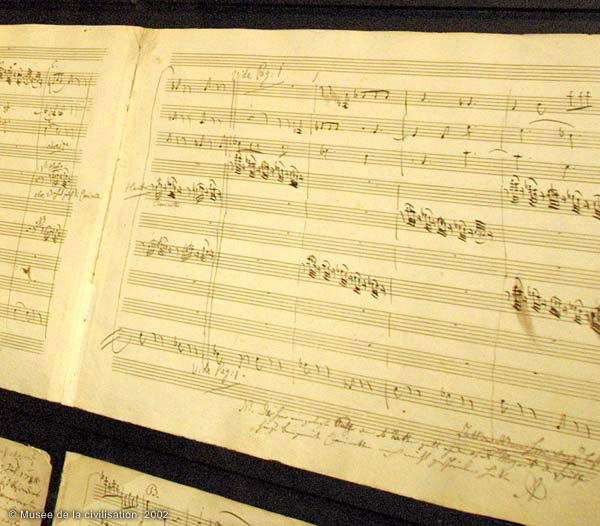
Allegro assai: Half Fast: Tempo I: Moderato: Tempo I [6:14]
video (YouTube) MP3 recording WAV recording The finale
(the first to be written) is a modern take on the most dissonant music written
by Mozart; the final half of the final movement of his 40th
Symphony. This section starts with what is very nearly a twelve-tone row. What
I have done here, as I have done several times in the past, is to see what I
would do with the key ideas of this piece written in my own style and form.
This is by no means an arrangement of the original, but instead is an entirely
new work. (Never fear—as I have never written in the twelve-tone style, which I
find obnoxious in the extreme, I have not done so here either.)
________________________________________________
Over the last decade I have preferred to write pieces from about 15 to 25
minutes long; this is most suited to the kind of music that I write. In our
fast-paced era of minute attention spans, what people want is music of much
shorter duration. Almost all composition contests are for very short pieces. I
have frequently urged performers to consider playing single movements, but this
happens infrequently. As a result I decided to write some short pieces for
violin and piano that could be played together for the same effect as a single
piece, but which would each stand alone.
All three pieces have
orchestral versions.
These three pieces were
first performed at Duke University on January 11, 2015, by Eric Pritchard,
violin, and Greg McCallum, piano.
Accidentals hold through
the measure and not beyond, and do not refer to other octaves. Eric Pritchard
edited the violin parts.